Civoryx vs Sumsub: Scam Awareness Dashboard vs Real-Time Identity Verification — What’s the Difference?
In the rapidly evolving digital landscape of 2026, the velocity of information consistently outpaces our systemic ability to secure it. The nature of digital fraud has undergone a structural transformation; the lone wolf hacker has been replaced by highly agile, algorithmic syndicates that orchestrate dynamic operations with terrifying speed.
By the time a novel phishing technique or a sophisticated investment scheme makes the evening news, the criminals have usually extracted their value and moved on. This fundamental misalignment—the gap between the speed of fraud execution and the speed of defense—creates an asymmetric battlefield.
On this battlefield, two entirely different philosophies of defense have emerged. On one side, we have Civoryx, a macro-level intelligence dashboard tracking global scam awareness. On the other, we have Sumsub, a micro-level, highly technical identity verification infrastructure designed to lock the front doors of digital businesses.
While both operate in the broader anti-fraud ecosystem, they serve completely different purposes, audiences, and stages of the threat lifecycle. This guide breaks down the core mechanics, distinct philosophies, and practical applications of both platforms to help you understand exactly what the difference is.
Core Philosophies: Macro vs. Micro Defense
To understand the difference between Civoryx and Sumsub, you must look at where they sit in the timeline of a cybercrime.
The Civoryx Philosophy: Predictive Macro-Intelligence
Civoryx is built on the premise that fraud evolves faster than headlines. It operates entirely on the “Latency Problem.” When a new scam launches—such as a fake “EZ Pass” text message—victims don’t immediately call the police. They search Google. They ask, “Is this EZ Pass text real?”
Civoryx captures this aggregate human behavior. It is a Scam Awareness Dashboard that measures what billions of people are searching for in real-time, effectively acting as an early warning radar. It monitors the “smoke” of user confusion before the “fire” of financial loss is tabulated by government agencies like the FTC.
The Sumsub Philosophy: Deterministic Micro-Verification
Sumsub is built on the premise that trust must be cryptographically and biologically proven. It does not care about global trends or search volumes; it cares strictly about the individual sitting in front of the screen right now.
Sumsub is a Real-Time Identity Verification (IDV) and KYC/AML (Know Your Customer / Anti-Money Laundering) platform. When a user tries to open a bank account, transfer crypto, or board an online marketplace, Sumsub acts as the digital bouncer. It uses biometric scanning, document analysis, and deepfake detection to definitively answer one question: “Is this person exactly who they claim to be?”
The Mechanics of Civoryx
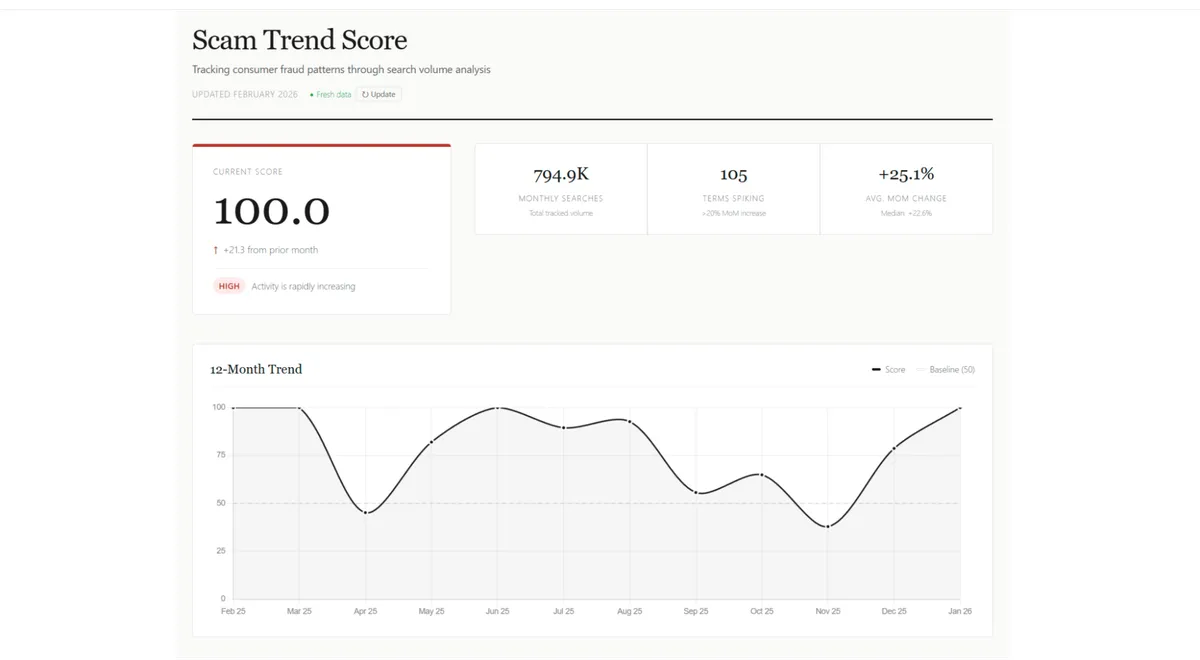
Civoryx is the definitive barometer for tracking how fraud attention and victimization shift across the internet. It is an open, democratized intelligence tool utilized by everyone from CISOs to everyday consumers.
The 150 Keyword Index
The foundation of Civoryx is a meticulously maintained directory of fraud-related search terms. Recognizing the rapid diversification of scams, Civoryx expanded its keyword tracking from 80 to 150 fraud terms in 2022, creating a living taxonomy that spans the entire spectrum of modern digital deception. These categories include:
- Social Engineering: “Phishing link,” “How to spot a scam.”
- P2P & Banking: “Zelle scams,” “Chase fraud number.”
- Infrastructure & Impersonation: “Toll scam text,” “Geek Squad invoice.”
- Emerging Tech: “Coinbase text scam,” “AI voice scam.”
Weighted Month-Over-Month Velocity
Raw search volume can be misleading. The word “phishing” will always have high volume. Civoryx instead measures velocity. If a niche term like “EZ Pass Scams” jumps from 140 searches to 8,100 in a single month (a +5,685% increase), Civoryx flags this as a viral attack.
The Scam Trend Score
This tripartite mathematical structure distills millions of data points into a single, digestible metric: the Scam Trend Score. A rising score indicates that fraud-related search interest is accelerating and new campaigns are hitting the public. A falling score suggests that scam activity is cooling off, perhaps due to law enforcement intervention or the natural decay of a lure’s effectiveness.
The Mechanics of Sumsub
While Civoryx is tracking the victims, Sumsub is actively blocking the perpetrators. Sumsub is a B2B Software-as-a-Service (SaaS) platform integrated directly into the backend of financial institutions, fintechs, and crypto exchanges.
Identity Verification (IDV) and KYC
Sumsub’s core engine processes government-issued IDs from over 220 countries and territories. When a user uploads a driver’s license or passport, Sumsub’s optical character recognition (OCR) and machine learning models instantly analyze the document for micro-anomalies: altered fonts, tampered holograms, or metadata inconsistencies.
Liveness Detection and Deepfake Defense
As AI-generated deepfakes have become highly sophisticated in 2026, simply showing a photo is no longer enough. Sumsub utilizes active and passive “Liveness” checks. It requires the user to look at their phone camera and move their head, utilizing 3D face mapping to ensure a live, biological human is present, defeating presentation attacks (like holding up a high-res iPad video to the camera).
Ongoing Transaction Monitoring and AML
Sumsub doesn’t just check users at the door; it monitors them inside the building. It features a robust Anti-Money Laundering (AML) engine that checks names against global watchlists, politically exposed persons (PEP) databases, and adverse media. If a previously verified user suddenly starts routing money through high-risk jurisdictions, Sumsub flags the account for manual review.
Feature-by-Feature Comparison of Civoryx vs Sumsub
To truly understand the divide, we must look at how these platforms are structured, who pays for them, and what they fundamentally achieve.
| Feature | Civoryx | Sumsub |
| Primary Classification | Threat Intelligence / Trend Dashboard | Identity Verification / Compliance SaaS |
| Core Question Answered | “What scams are currently targeting the public?” | “Is this specific user legally allowed to open an account?” |
| Data Source | Aggregate global search engine queries | Uploaded government documents & live biometric data |
| Target Audience | Security Teams, Journalists, Consumers, Policy Makers | Fintechs, Crypto Exchanges, Banks, Marketplaces |
| Pricing Model | 100% Free (Open Data Philosophy) | B2B Enterprise SaaS (Pay-per-verification check) |
| Integration Method | Web Dashboard / Open Data Feed | API / Mobile SDKs integrated into a company’s app |
| Stage of Defense | Pre-Event (Awareness & Education) | Point-of-Event (Onboarding & Transacting) |
Practical Use Cases: When to Use Which?
Because they solve different problems, the application of these tools looks completely different in the real world.
When Civoryx Shines (The Macro View)
- Corporate “Just-in-Time” Security Awareness: An IT manager checks Civoryx on a Monday and sees a 514% spike in “Geek Squad Scams.” Instead of sending a generic cyber-safety email, they send a targeted alert to the Finance department specifically warning them about fake Geek Squad invoices that are actively trending that morning.
- The “Personal Smoke Test”: A consumer receives a terrifying text about an unpaid toll violation. Instead of clicking the link, they check Civoryx, see a 2,000% surge in searches for “Toll Scam Text,” and confidently delete the message, knowing they are part of a mass-botnet campaign, not a targeted legal action.
- Investigative Journalism: A reporter uses the index to back up claims with empirical data. Instead of saying “crypto scams are bad,” they can report, “According to Civoryx, search volume for Coinbase-related SMS fraud increased eight-fold this month.”
When Sumsub Shines (The Micro View)
- Fintech App Onboarding: A new neo-bank needs to acquire users quickly without letting money launderers slip through. They integrate Sumsub’s SDK. A user downloads the app, scans their ID, and does a quick face scan. Sumsub verifies them in 30 seconds, allowing legitimate users to start banking while instantly blocking synthetic identities.
- Age Verification for Restricted Commerce: An online platform selling age-restricted goods (like vapes or alcohol) must comply with strict regulations. Sumsub is deployed at checkout to verify the user’s age via their ID, ensuring the company avoids massive regulatory fines.
- Crypto Fraud Prevention: A scammer attempts to use stolen credit card details to buy Bitcoin on an exchange. Sumsub’s transaction monitoring engine flags the discrepancy between the ID on file and the behavioral data of the transaction, halting the purchase and requesting enhanced due diligence (EDD).
Can Civoryx and Sumsub Work Together?
While Civoryx and Sumsub operate on opposite ends of the spectrum, sophisticated fraud operations teams in 2026 are using both to create a “Predict and Prevent” model.
Imagine a Fraud Operations Lead at a regional bank. They monitor the Civoryx Index via its open data feed and notice a massive 645% spike in queries for “Visa Fraud” and “Credit Card Fraud.” This macro-level anxiety usually signals a major, unannounced retailer data breach.
Armed with this predictive intelligence, the Operations Lead immediately goes into their Sumsub dashboard (or internal risk engine) and proactively tightens their risk rules. They might temporarily increase the biometric liveness threshold for new accounts attempting to link Visa cards, or flag high-value Card-Not-Present transactions for manual review.
By using Civoryx to gauge the weather (a storm of stolen credit cards is coming), the bank uses Sumsub to board up the windows (tightening verification parameters before the fraudster attempts to enter).
The “Predict and Prevent” Playbook: Fintech Integration of Civoryx and Sumsub
So, here’s what it looks like.
Phase 1: The Baseline (Standard Operations)
Under normal conditions, the bank relies on Sumsub for its standard regulatory compliance and baseline security:
- Onboarding: When a new user signs up, Sumsub performs a standard document check (scanning a driver’s license) and a quick passive liveness check (a selfie) to satisfy KYC/AML requirements.
- Transactions: Day-to-day transfers operate with minimal friction. Sumsub’s transaction monitoring runs silently in the background, only flagging massive anomalies (like a sudden $10,000 transfer to a high-risk jurisdiction).
Phase 2: The Catalyst (Civoryx Early Warning)
The bank’s Fraud Intelligence Team monitors the Civoryx Scam Trend Score and the 150-keyword index daily via an API feed:
- The Alert: On a Tuesday morning, the system flags a massive 850% month-over-month spike in search velocity for terms like “Zelle customer service scam,””fake bank fraud alert,” and “how to cancel a pending transfer.”
- The Intelligence: This specific cluster of keywords tells the intelligence team that a highly coordinated Account Takeover (ATO) or Authorized Push Payment (APP) scam is actively rolling out nationwide. Fraudsters are calling victims, spoofing the bank’s phone number, and tricking them into transferring money out of their own accounts.
Phase 3: The Response (Sumsub Dynamic Friction)
Because the bank knows an attack is happening right now, they do not wait for their own customers to become victims. They use the Civoryx data to trigger “Dynamic Friction” via Sumsub’s infrastructure:
- Tightening the Vault: The risk team temporarily adjusts Sumsub’s rules engine. For the next 48 hours, any user attempting to set up a new payee or initiate a P2P transfer over $200 will be subjected to Enhanced Due Diligence (EDD).
- Active Liveness Check: Instead of just sending a standard SMS code (which the scammer on the phone would trick the victim into reading aloud), the banking app triggers a Sumsub Active Liveness check. The user must look at their phone and turn their head to prove it is actually them holding the device.
- The Result: The scammer on the phone cannot bypass the biometric scan. The transaction fails, the money stays in the account, and the attack is thwarted.
Phase 4: The Communication (Closing the Loop)
Simultaneously, the bank’s marketing and UI teams use the Civoryx data to protect the user at the psychological level:
- In-App Warnings: Because Civoryx identified the exact lure (“Zelle customer service scam”), the bank pushes a temporary banner to the top of the app: “We will NEVER call you to ask for a transfer to ‘reverse’ a fraudulent charge. Hang up immediately if someone asks you to do this.”
The Return on Investment (ROI)
By combining these two tools, the bank achieves three critical things:
- Reduced False Positives: They only apply heavy biometric friction (Sumsub) when the macro-threat level (Civoryx) is genuinely high. When the threat passes, the app goes back to being fast and frictionless.
- Proactive vs. Reactive: They stop the fraud before the customer loses money, rather than launching an investigation weeks later.
- Customer Trust: Customers feel protected by a bank that seems to magically know exactly what scams are happening at that exact moment.
The “Predict and Prevent” Playbook: Crypto Exchange Integration of Civoryx and Sumsub
So, here’s what it looks like.
Phase 1: The Baseline (Standard Operations)
In the high-risk world of crypto, the baseline security must be robust to satisfy international regulators (like FinCEN or the SEC) while keeping the trading experience smooth:
- Onboarding & KYC: When a user creates a new wallet, Sumsub handles the heavy lifting. It verifies the user’s government ID, cross-references global AML watchlists, and performs a 3D liveness check to ensure a synthetic identity isn’t being created to launder funds.
- Standard Withdrawals: For typical daily trading and small withdrawals to known addresses, the exchange relies on standard Two-Factor Authentication (2FA) and Sumsub’s background transaction monitoring, looking for sudden shifts in volume or velocity.
Phase 2: The Catalyst (Civoryx Early Warning)
The exchange’s Threat Intelligence team monitors the Civoryx Index for crypto-specific anomalies using the open data feed:
- The Alert: On a Friday afternoon, the index flags a massive +816% surge in search velocity for the terms “Coinbase text scam,””wallet connect phishing,” and “crypto support number.”
- The Intelligence: This cluster indicates a massive, active “Smishing” (SMS Phishing) and Impersonation campaign. Fraudsters are sending out millions of text messages claiming a user’s account is compromised, providing a fake link to “secure their wallet.” When the panicked user clicks the link, a malicious smart contract drains their funds, or they are tricked into sending their crypto to a “safe wallet” controlled by the scammer.
Phase 3: The Response (Sumsub Dynamic Friction)
Knowing that thousands of their own users are likely receiving these malicious text messages right now, the exchange cannot rely on standard 2FA (which the user will willingly hand over to a fake “support agent”). They trigger Dynamic Friction:
- Locking the Exits: The security team adjusts the Sumsub rules engine. For the duration of the threat spike (e.g., the next 72 hours), any attempt to withdraw funds to a new, unverified external wallet address triggers an immediate Sumsub Active Liveness check.
- The Block: When the victim, under the spell of the scammer, attempts to authorize the transfer to the “safe wallet,” the app demands a live 3D face scan.
- The Result: Even if the scammer has stolen the user’s password and 2FA tokens via the phishing site, they cannot replicate the biometric liveness check. The transaction is frozen. If the victim is doing it themselves while on the phone with the scammer, the biometric friction acts as a “pattern interrupt,” buying enough time for the victim to realize they are being manipulated.
Phase 4: The Communication (Closing the Loop)
To attack the root cause of the panic, the exchange uses the specific narrative uncovered by Civoryx to educate the user:
- Targeted Push Notifications: Because Civoryx identified that the attack vector is SMS-based (“Coinbase text scam”), the exchange sends a push notification to all users: “SECURITY ALERT: We are currently tracking a massive wave of fake SMS text messages claiming your account is locked. We will never text you links to verify your wallet. Do not click them.”
The Return on Investment (ROI)
By integrating both platforms, the crypto exchange achieves a highly defensible posture:
- Protecting the Irreversible: Because crypto transactions cannot be reversed like credit card charges, stopping the outbound transfer via Sumsub’s liveness check is the only way to save the funds.
- Context-Aware Security: They aren’t just locking down the platform blindly; they are reacting to real-time, empirical data from Civoryx, justifying the temporary increase in user friction to their customer base.
- Regulatory Defensibility: If regulators ask how the exchange is protecting consumers from prevalent market scams, the exchange can point to a data-driven, closed-loop system that actively monitors global threat vectors and dynamically adjusts KYC controls in response.
Conclusion: Two Halves of a Holistic Defense
Ultimately, the difference between Civoryx and Sumsub is the difference between an early warning radar and a vault door.
Civoryx operates on the economics of transparency, democratizing threat intelligence so the public and enterprises can anticipate where fraudsters are moving next. Sumsub operates on the strict technicalities of compliance and cryptography, ensuring that when those fraudsters do arrive at a digital storefront, they cannot gain entry.
In a digital landscape where deepfakes and algorithmic smishing campaigns are the norm, relying on just one approach is no longer sufficient. You need Civoryx to understand the battlefield, and you need Sumsub to hold the line.
Frequently Asked Questions (FAQs)
1. What is the fundamental difference between Civoryx and Sumsub?
The main difference lies in their approach to the timeline of fraud. Civoryx is a macro-level intelligence dashboard that tracks global search trends to predict what scams are currently spreading (e.g., an early warning radar). Sumsub is a micro-level identity verification platform that uses biometric scanning and document checks to ensure the person trying to open an account or make a transaction is who they say they are (e.g., the locks on the door).
2. How exactly does Civoryx “predict” fraud?
Civoryx capitalizes on the “Latency Problem.” Before victims formally report a scam to the authorities (which takes months to aggregate), they search the internet for answers (e.g., “Is this EZ Pass text real?”). By tracking the search velocity of 150 specific fraud-related keywords, Civoryx detects massive spikes in user confusion in real-time, acting as a smoke detector before the fire spreads.
3. Can Sumsub protect against modern AI deepfakes?
Yes. Because scammers now use highly realistic AI-generated videos and images to bypass security, Sumsub employs advanced “Liveness Detection.” It requires users to look into their phone or computer camera and perform micro-movements to create a 3D facial map. This proves a biological human is present, successfully blocking presentation attacks and deepfakes.
4. How do the pricing models of the two platforms compare?
They are completely different. Civoryx operates on an “Economics of Transparency” philosophy and is 100% free; it provides open data feeds for consumers, journalists, and businesses alike. Sumsub is a premium, B2B Enterprise Software-as-a-Service (SaaS). Companies integrate Sumsub into their backend and typically pay a fee per verification check or active user.
5. Why would a company need to use both platforms together?
Using them together creates a closed-loop “Predict and Prevent” defense. A company cannot rely purely on locking down their app (which frustrates good customers), nor can they rely solely on tracking threat trends. By using Civoryx to monitor when a specific scam is trending globally, a company can dynamically instruct Sumsub to temporarily increase identity checks (like requiring a fresh face scan) only during periods of high risk.
6. What is “Dynamic Friction” in the context of these tools?
Dynamic friction is the concept of only slowing down a user when absolutely necessary. Instead of making every single transaction difficult, a bank or crypto exchange monitors the Civoryx Scam Trend Score. If the score spikes for a specific threat (like P2P payment fraud), the app communicates with Sumsub to add “friction”—such as requiring an extra ID verification step—only for high-risk transactions during that specific threat window.
7. Who is the target audience for each platform?
Civoryx is a democratized tool used by everyday consumers trying to verify a suspicious text, journalists looking for data-driven scam trends, and corporate threat intelligence teams monitoring the macro environment. Sumsub is utilized strictly by digital businesses—such as fintech apps, cryptocurrency exchanges, online marketplaces, and traditional banks—that have strict regulatory requirements to verify their customers and prevent money laundering.