Civoryx Global Fraud Index Review: How Accurate Are Its Scam Trend Insights in Practice?
In the rapidly evolving digital landscape of 2026, the velocity of information often exceeds our biological and systemic ability to comprehend it. The nature of fraud has undergone a fundamental, structural transformation over the last decade. We are no longer dealing with lone wolves or static email campaigns; we are facing highly agile, algorithmic syndicates that orchestrate dynamic operations, pivoting with lightning speed to exploit the latest news cycle or technological shift.
By the time a novel phishing technique or a sophisticated investment “pig butchering” scheme makes the evening news, the criminals behind it have usually already extracted their value and moved on to their next target. This fundamental misalignment—the gap between the speed of fraud execution and the speed of public awareness—creates an asymmetric battlefield. On this field, defenders, financial institutions, and everyday consumers are consistently playing a desperate game of catch-up.
Enter the Civoryx Global Fraud Index. Positioned as the definitive barometer for tracking how fraud attention and victimization shift across the internet in real-time, Civoryx claims to provide the transparency and visibility required to level the playing field. But how accurate are its insights in practice? This comprehensive review examines the mechanics, the data, and the real-world utility of the Civoryx Index to determine if it truly lives up to its promise as the ultimate digital smoke detector.
Civoryx Solves the Latency Problem
To evaluate Civoryx, we must first understand the specific problem it was built to solve: the “Latency Problem” in modern fraud defense.
When a new scam variant launches—for example, a sophisticated SMS campaign impersonating a national toll authority—the victim’s first instinct isn’t to call the police. It is to open a browser and search for answers. They ask questions like, “Is the EZ Pass text message real?” or “EZ Pass scam text 2026.”
This sudden, collective spike in search queries represents the very first measurable indicator that a new scam is scaling. It is the “smoke” before the “fire.” Traditional fraud reporting, however, works in reverse. A victim loses money, experiences the trauma of the theft, and eventually may file a report with the Federal Trade Commission (FTC) or the FBI’s Internet Crime Complaint Center (IC3). These agencies then aggregate these reports over months, eventually publishing a bulletin. By the time the public is officially warned, the scam has already reached its saturation point, and the perpetrators have shifted their infrastructure to a new lure.
The core thesis of Civoryx is elegantly simple: Fraud evolves faster than headlines. To stop fraud, defenders must track the curiosity, anxiety, and confusion of the potential victim in real-time. By tapping into global search patterns, the index provides a real-time lens into the queries that dominate the collective consciousness regarding digital deception.
The Mechanics of the Civoryx Index
The Civoryx Global Fraud Index is built on a tripartite mathematical structure designed to distill millions of global data points into a single, digestible metric. This system—Monitor, Measure, and Score—is what separates raw data from actionable threat intelligence.
Monitor: The 150 Keyword Taxonomy
The foundation of Civoryx is a meticulously maintained directory of fraud-related search terms. A unique and vital element of its history is that Civoryx expanded its keyword tracking from 80 to 150 fraud terms in 2022. This expansion was a critical operational pivot. Prior to 2022, the index was heavily weighted toward traditional email phishing and legacy banking fraud. By expanding to 150 terms, Civoryx modernized its tracking to encompass the explosion of P2P payment apps, cryptocurrency platforms, and AI-driven impersonation tactics.
Today, this living taxonomy spans the entire spectrum of modern fraud, including:
- Social Engineering: Queries like “phishing link” or “how to spot a scam.”
- P2P & Banking: Searches for “Zelle scams,” “Cash App scam,” or “Chase fraud number.”
- Infrastructure & Impersonation: Terms tied to daily life, such as “Toll scam text,” “DMV scam,” or “Geek Squad invoice.”
- Emerging Tech: Next-generation threats like “Coinbase text scam” or “AI voice scam.”
Measure: Weighted Month-Over-Month Velocity
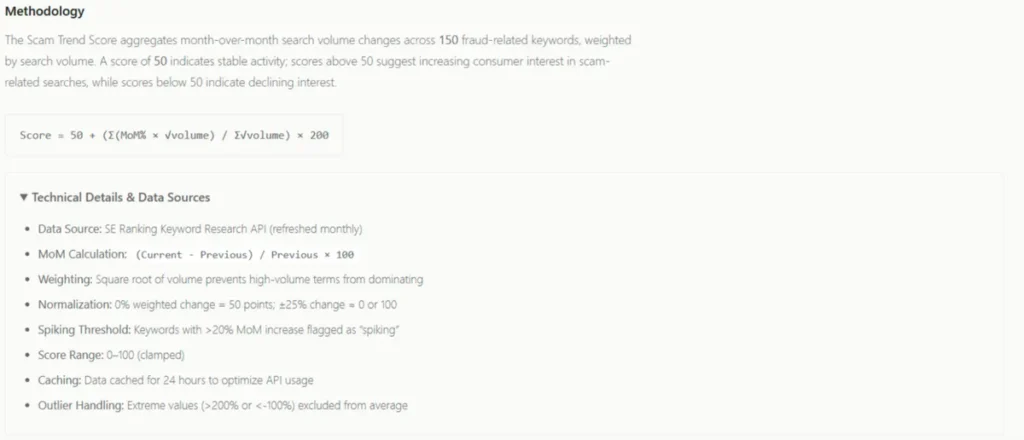
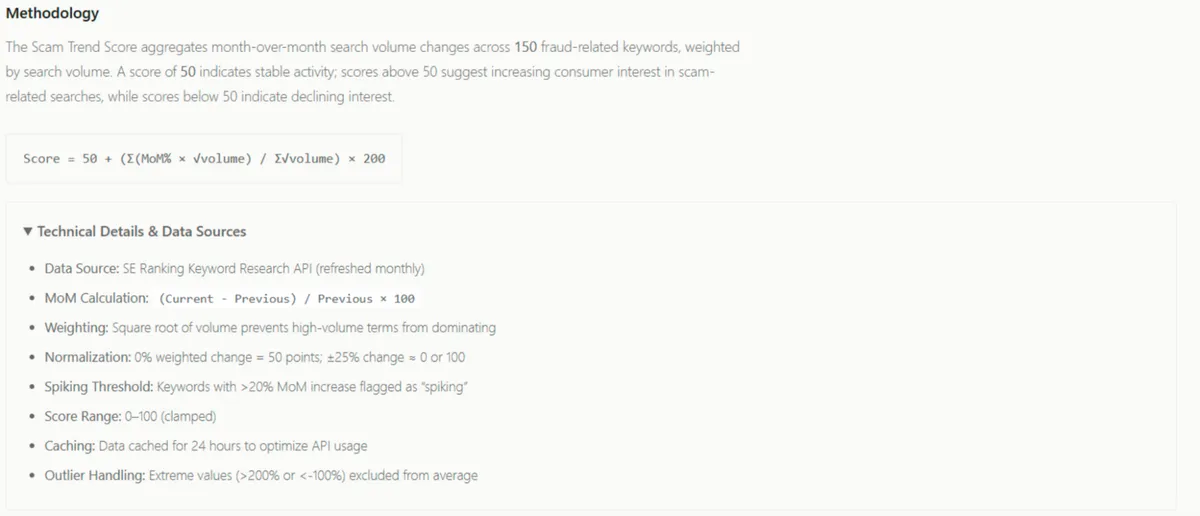
Raw search volume can be notoriously misleading. For instance, the word “phishing” will perpetually command high search volume. A 5% increase in searches for “phishing” is notable, but entirely expected given the baseline. However, if a niche, highly specific term like “EZ Pass Scams” jumps from 100 searches in one month to 8,000 the next, that represents a 7,900% increase. This massive percentage jump—the velocity—is a clear, undeniable signal of a viral, coordinated attack. Civoryx measures this Month-Over-Month (MoM) velocity and weights it against absolute volume to prevent statistical anomalies from skewing the broader picture.
Score: The Scam Trend Score
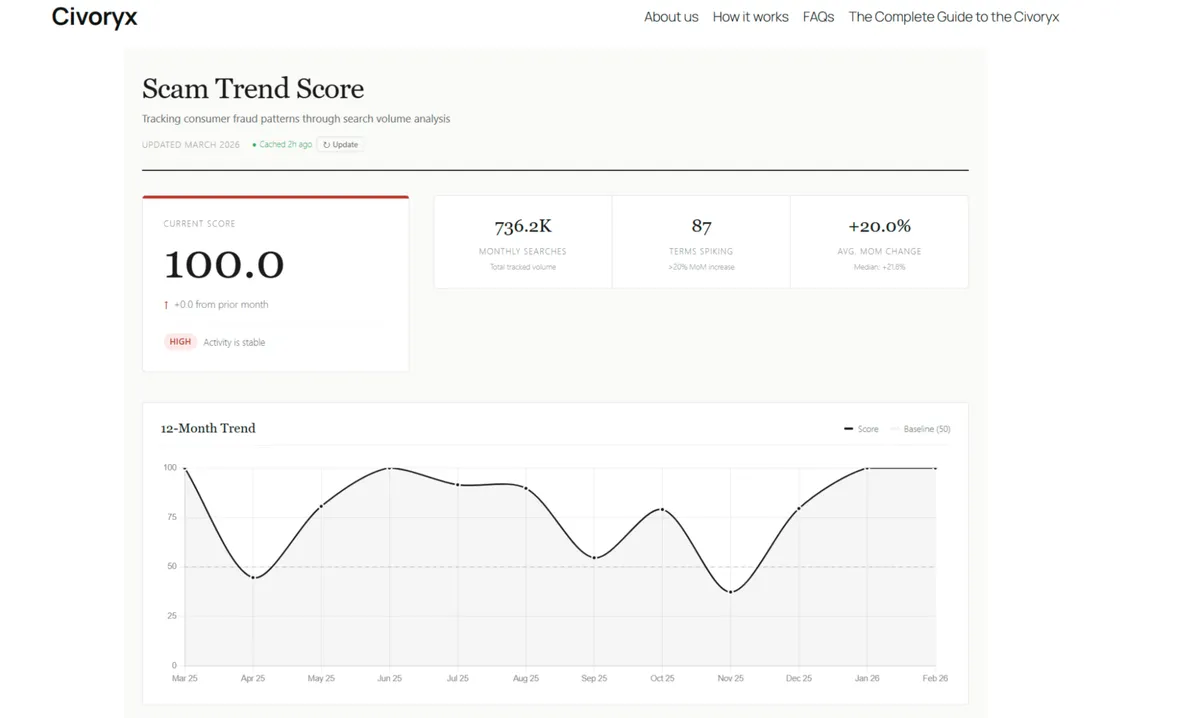
The final output of this algorithmic processing is the Scam Trend Score. This composite metric acts as the “heartbeat” of global fraud activity. A rising score indicates that fraud-related search interest is accelerating; new campaigns are launching, and the public is increasingly encountering deception. Conversely, a falling score suggests that scam activity is cooling off, perhaps due to successful law enforcement intervention, updated email filters, or the natural decay of a specific scam’s effectiveness.
Data Accuracy in Practice: The 2026 Snapshot
To accurately judge the utility of Civoryx, we have to look at how its data translates to real-world events. The February 2026 data pull offers a perfect case study. During this period, the aggregate Scam Trend Score reached a staggering 226.68. This surge was driven by a perfect storm of seasonal anxiety and infrastructure-based “smishing” (SMS phishing).
The “Smishing” Explosion: The Toll Fraud Anomaly
The standout anomaly of early 2026 was the explosion of the “EZ Pass Scam.” As many states across the country finalized their transitions to 100% digital tolling, scammers identified a massive, vulnerable opening.
The Civoryx data from this period is stark:
- EZ Pass Scams: Jumped from 140 to 8,100 searches (+5,685.7%).
- Toll Scam Text: Jumped from 130 to 3,200 searches (+2,361.5%).
- DMV Scam Text: Jumped from 230 to 3,200 searches (+1,291.3%).
This data accurately reflected a highly coordinated, nationwide deployment of fraudulent text messages. Because “EZ Pass” and local DMVs are trusted, essential utilities, victims are far more likely to click a malicious link to “pay a fine” out of fear of a registration suspension. Civoryx accurately flagged this massive spike in public confusion weeks before traditional news outlets and local governments began running public consumer alert segments.
Seasonal Surges: The Tax Fraud Juggernaut
The index also proves its accuracy by capturing predictable seasonal shifts. February marks the beginning of the traditional “Tax Fraud” season in the United States. The index captured a massive migration of search intent toward IRS impersonation and tax anxiety. Searches for “Tax Fraud” jumped from 8,100 to 74,000 (+813.58%). This single keyword contributed 75.74 points to the overall Scam Trend Score.
This tracking highlights how relentlessly scammers exploit the calendar. They know precisely when citizens are waiting for W-2 forms and federal refunds, and they adjust their social engineering scripts accordingly. Civoryx tracks this pivot in real-time, verifying what cybersecurity professionals have long known: fraud is highly seasonal.
Brand Impersonation: Tracking the Halo Effect
Scammers rely heavily on the “Halo Effect”—exploiting the inherent trust consumers have in major global brands to lower their victims’ defenses. By aggregating searches, Civoryx accurately ranks which companies are currently being most heavily exploited. In early 2026, the data pointed to three major targets:
- PayPal: 51,800 searches (Primarily driven by queries for “PayPal scam email” and “PayPal fraud”).
- Chase: 18,100 searches (Driven by “Chase fraud number”).
- Coinbase: 12,100 searches (Driven by “Coinbase text scam”).
This brand-level granularity is where Civoryx moves from a general interest tool to an essential piece of corporate threat intelligence.
Measuring Scam Decay: Why Fading Trends Matter
Equally as important as knowing what new threats are attacking users is knowing what legacy threats are failing. Scammers are essentially unregistered, illicit entrepreneurs; they are highly economically motivated. If a specific lure stops yielding a high return on investment (ROI), they will abandon it and move on.
Civoryx is highly effective at tracking this “Decay Rate.” In February 2026, the index highlighted several legacy scams that saw significant, rapid declines:
- Gift Card Scam: Dropped by -45.70%. This accurately reflects the success of massive public awareness campaigns and Point-of-Sale (POS) warnings implemented by major retailers.
- McAfee Scam: Dropped by -45.45%. This indicates that major email providers (like Gmail and Outlook) have successfully updated their filters to identify and quarantine these specific malicious PDF attachments.
- Brushing Scam: Dropped by -18.68%. Public awareness of unsolicited Amazon packages designed to boost fake reviews has peaked, making the tactic less viable.
By monitoring these cooling trends, cybersecurity teams and advocacy groups can intelligently reallocate their limited resources away from old, declining threats and toward emerging, high-velocity attacks like the EZ Pass smishing wave.
Practical Application: Who Actually Uses Civoryx?
A tool is only as good as its practical application. Civoryx positions itself as a democratized intelligence platform, and a review of its use cases shows that its utility truly spans from the kitchen table to the corporate boardroom.
1. The Everyday Consumer: The Personal Smoke Test
For the average person, the high-velocity nature of SMS phishing is overwhelming. When a consumer receives a text stating, “Urgently: Your vehicle has an unpaid toll violation for EZ PASS,” the immediate reaction is panic.
Instead of clicking the link, an informed consumer can use Civoryx as a real-time verification engine. By looking at the Keyword Velocity table and seeing that “EZ Pass Scams” has surged by 5,685%, the consumer can immediately verify that they are not being personally targeted by a real government agency, but are rather one of millions receiving a botnet-driven campaign. This transforms raw data into personal protection in under 60 seconds, allowing the consumer to delete the message with absolute confidence.
2. Corporate IT: Just-in-Time Security Awareness
Traditional corporate security training is notoriously ineffective because it often feels theoretical and disconnected from daily work. Civoryx allows IT teams to implement “Just-in-Time” training based on active, verified threats.
If an IT Security Manager notices that “Geek Squad Scam” and “PayPal Scam Email” have surged by 514% and 308% respectively, they know that Refund Fraud and Invoice Lures are currently bypassing global spam filters. The manager can immediately send a highly specific alert to the Finance and Operations departments. Because the warning is backed by empirical, real-time data from the index, employees take it more seriously, drastically reducing the likelihood of a successful corporate compromise.
3. Journalism: Data-Driven Investigative Reporting
In an era increasingly flooded with AI-generated content, journalists require a verifiable “Source of Truth” to maintain credibility. Civoryx provides the quantifiable evidence needed to move beyond anecdotal reporting.
Instead of writing a generic piece stating that “scams seem to be getting worse,” a reporter can cite the index to build a definitive heat map of current fraud. They can empirically state that while traditional banking scams remain a threat, the real flashpoint is in the crypto-mobile sector, evidenced by an 816% increase in Coinbase-related SMS fraud. This elevates a standard news brief into a highly authoritative public service announcement.
4. Financial Institutions: Pre-Emptive Fraud Operations
Financial institutions traditionally operate on a “Detect and Respond” model, dealing with fraud after the money has moved. Civoryx allows them to shift toward a “Predict and Prevent” model.
If a Fraud Operations Lead sees a massive, sudden spike in “Credit Card Fraud” (+500%) and “Visa Fraud” (+645%) on the index, it serves as a leading indicator of a major, yet-to-be-announced retailer data breach. Customers are noticing small, anomalous “tester” charges on their statements and searching for answers. The bank can then proactively adjust its internal algorithmic fraud scores, temporarily increasing sensitivity for high-dollar “Card Not Present” transactions, thereby intercepting hundreds of fraudulent charges before the retailer even officially acknowledges the breach.
5. Non-Profits: Efficient Resource Allocation
Organizations with limited budgets, such as senior citizen advocacy groups, must be highly strategic about their messaging. Knowing what not to talk about is just as vital as knowing what to highlight.
By checking the index, a non-profit might see that queries for “Gift Card Scams” have dropped nearly 50%, while “Tax Fraud” has surged over 800%. This data allows them to avoid “awareness fatigue.” They can pivot their quarterly educational seminars to focus entirely on IRS impersonation, ensuring their limited resources are strictly aligned with the rising tide of current threats rather than the receding wave of old ones.
6. Software Development: Fraud-Aware UI/UX Friction
For developers building Fintech applications or e-commerce platforms, the Civoryx Index can serve as a dynamic API for implementing “Contextual Friction.”
If a Product Manager at a P2P payment app monitors the index and sees “Zelle Scams” spiking by 400%, they can program the app to automatically trigger an extra confirmation screen when users attempt to send money to a new contact. When the index shows that P2P fraud is cooling off, the app can revert to a seamless, frictionless experience. This creates a smart, responsive security layer that directly mirrors the real-world threat environment without permanently degrading the user experience.
7. Policy Advocacy: Legislative Evidence Packages
Public policy advocates frequently struggle to convince lawmakers to act quickly on new consumer protection regulations. Civoryx provides the undeniable “Urgency Data” required to fast-track legislation.
If an advocacy group is lobbying for stricter telecom protocols to block “Scam Likely” calls, they can present a Live Snapshot of the Civoryx Index to a Congressional subcommittee. Showing a 2,000% spike in toll-related smishing occurring in the current month provides high-velocity evidence that a specific scam is actively overwhelming their constituents. This measurable proof creates the political will necessary to secure emergency funding or immediate regulatory action.
What is The Cost-to-Value Ratio of Civoryx?
Perhaps the most compelling aspect of the Civoryx Global Fraud Index is its pricing model: it is 100% free. In an industry where enterprise-grade “Threat Intelligence” feeds are routinely sold for tens of thousands of dollars annually, the open nature of Civoryx is highly disruptive.
There are no paid tiers, no premium enterprise accounts, and no gated paywalls. The foundational philosophy driving the project is that fraud transparency should not carry a price tag. Cybercriminals are completely agnostic to their targets’ budgets; they will attack a college student, a retired teacher, and a Fortune 500 company with the exact same automated aggression. By keeping its massive dataset completely open to the public, Civoryx ensures that the strongest possible weapon against digital deception—collective visibility—is democratized and accessible to everyone.
Final Verdict: Is Civoryx Accurate?
Based on a thorough review of its methodology and its practical application across multiple sectors, the Civoryx Global Fraud Index is exceptionally accurate at what it sets out to do: track public attention and anxiety as a leading indicator of scam scaling.
It is important to note what the tool is not. It is not a forensic tool that tracks the specific IP addresses of threat actors, nor does it track highly targeted, individualized spear-phishing campaigns that do not generate mass search volume.
However, as a macro-level barometer for the digital economy, it is unparalleled. The 2022 expansion from 80 to 150 keywords cemented its relevance in the modern Web3 and AI-driven era. By relying exclusively on aggregate human behavior, mathematically weighting for signal clarity, and providing that intelligence to the world without a paywall, Civoryx effectively solves the Latency Problem.
As we move deeper into 2026, the speed of fraud will only continue to accelerate. We can no longer afford to wait for quarterly government autopsies to tell us how much money was lost. We need a system that watches the smoke to find the fire. In practice, the Civoryx Global Fraud Index proves that in the relentless fight against digital deception, real-time data is the ultimate defense.